
No Hardin County 72-Hour Feed
The Hardin County Sheriff publishes one Inmate Roster, not separate current, released, 24-hour, and 72-hour pages. The direct feed and official feature manifest likewise expose one roster module. MCCC does not publish a second rolling list. A three-day result must therefore be calculated from completed Release Date timestamps and labeled as an unofficial reader-created window.
The broader interval is useful after several days away from the record, but it does not cure gaps in the source. No official cadence says when the roster refreshes. No published retention rule promises that every release will remain visible for three days. A result that falls within the window is useful evidence; an empty result cannot establish that nobody left MCCC.
Calculate Hardin County 72-Hour Releases
A rolling 72-hour period means the three days immediately before the current moment. It is more precise than selecting three calendar dates. If the check occurs on Monday afternoon, an event from Friday morning may already be outside the interval, while one from Friday evening may still qualify. Record the cutoff first so each result is judged by the same rule.
- Write down the current date and time, then subtract 72 hours to establish the exact start of the period.
- Open the official sheriff roster and inspect each possible match rather than relying on the feature title.
- Match name, date of birth, inmate ID, booking time, arresting agency, and charge details before using a timestamp.
- Include only records with completed Release Date values after the cutoff and before the current check time.
- Call MCCC at 740-387-7434, option 2, for a missing, blank, delayed, or disputed event.
- Use the Hardin Municipal or Common Pleas docket to identify the legal action, then request the discharge manner if destination remains unclear.
A focused same-day inquiry belongs on the Hardin County 24-Hour Releases page. The 72-hour method is designed for a wider sweep and should not merely copy a “today” list.
The live Hardin sheriff roster is the source to inspect before applying the three-day cutoff.
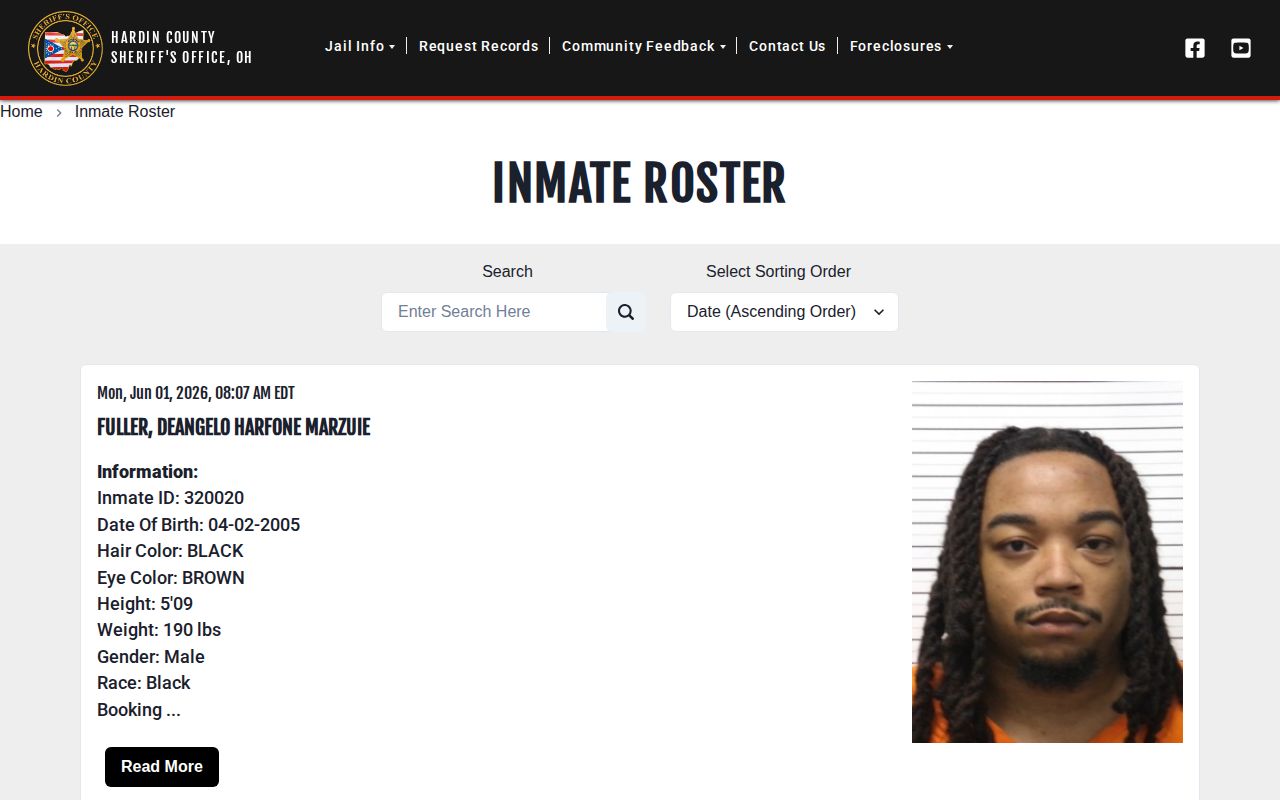
The captured screen shows the source layout. Current entries, dates, and retention can differ from what the image recorded.
Hardin County Three-Day Release Fields
The roster fields serve two tasks: identify the correct booking and establish when the feed recorded its end. They do not fully explain why custody ended. Read the identity and event fields together, then obtain the authority or discharge manner from the custodial record and court docket when needed.
| Roster field | Value in a 72-hour review |
|---|---|
| Name, inmate ID, and date of birth | Separate the intended person from similar names and identify the booking for follow-up. |
| Booking Date and time | Links the release to the correct MCCC stay. It does not state the filing date of the court case. |
| Release Date and time | Determines whether a completed event falls inside the rolling period. A blank field is unresolved. |
| Arresting agency | Helps locate the source case and agency context for the booking. |
| Charge and statute | Helps distinguish records and find the corresponding court docket. It is not the final disposition. |
| Physical description and image | Can support identity comparison, but neither proves the current custody state. |
The feed does not show bond amount, release reason, releasing authority, court order, or transfer destination. Ohio Revised Code 341.02 requires a jail register with the prisoner's name, residence, cause and date of commitment, plus the date and manner of discharge. That register is the stronger fallback when the roster event lacks context.
Note: Ask for one identified booking and date range so the records custodian can locate the relevant discharge entry without a broad search.
Hardin County Weekend Release Checks
A three-day review is most useful when a one-day window would cut across a weekend, holiday, or several missed checks. Still, the source does not promise weekend posting or a next-business-day catch-up. Court entries can also lag the judicial action by at least 24 hours and sometimes longer. The docket may show the judge's authority before the jail posts a timestamp, or the roster may show an exit before the docket update is easy to find.
Use the date and time of each source rather than forcing them into one event. A bond order is legal authority. A release timestamp reflects the custodial feed's event. A direct jail confirmation addresses physical status. If those records differ, ask the jail when it received the order, whether processing finished, and whether any detainer or transfer followed.
Hardin County's regional system adds distance to the process. The local court and some bond activity occur in Kenton, while MCCC performs physical release in Marion. A Monday docket check may not answer exactly when a weekend departure occurred. The register or release sheet is better suited to that question.
Hardin County Release Retention Quirk
The roster's retained released entries make a three-day check possible in principle, but the observed data also warns against calling the whole feature “recent.” On July 31, 2026, the feed returned 42 records. Five completed Release Date fields were dated June 1, while 37 fields were blank. Released entries had remained visible for about 59 days on that observation date.
That snapshot does not create a fixed retention policy. It only proves that the official roster was not current-only and was not a genuine rolling 72-hour list at that time. A person can remain displayed long after release, and a newer event can still be delayed or missing. The correct filter is the exact timestamp, not the record's continued presence.
Keep a simple audit trail when precision matters: note when the roster was checked, record the inmate ID and booking time, preserve the displayed Release Date, and write down which office confirmed the result. Do not treat an old screenshot as proof of today's status.
Note: No official publication schedule was found, so never promise that a release will appear by a set hour or day.
Hardin County Release or Transfer
An MCCC release timestamp closes the local booking in the feed. It does not always mean the person entered the community. A Hardin defendant sentenced to state prison may leave MCCC for an ODRC institution. Another county, federal authority, or immigration authority may also take custody. Ask for the manner of discharge and receiving agency when the difference matters.
| Record situation | Best next source | What it can establish |
|---|---|---|
| Completed MCCC release timestamp | MCCC status line or jail register | Physical departure and, if recorded, discharge manner or destination. |
| Blank field or no roster match | MCCC direct status check | Whether the person remains housed, was released, or was transferred. |
| Hardin court order | Municipal or Common Pleas clerk | Legal authority such as bond, dismissal, time served, or sentence. |
| State-prison sentence or transfer | ODRC Offender Search | Ohio prison status, release detail, or APA supervision when publicly shown. |
| Custody-change alert | Ohio VINE | Status relayed from a participating source, not a certified discharge record. |
The ODRC Offender Search is for Ohio prison and departmental supervision records, not every jail-only Hardin stay. Choose Released, APA Supervision, Judicial Release, or All as the question requires. For one specific local person whose history falls outside three days, use the full Hardin County released-inmate lookup.
Request Hardin County Release Records
A date-bounded records request is the durable substitute for an absent 72-hour feed. Start with MCCC because the regional facility houses and releases Hardin detainees. Consult Hardin Sheriff records when the requested roster or report belongs to that office. Supply the person's name, date of birth or inmate ID, approximate booking date, and the precise three-day range.
Ask for the jail-register entry, release sheet, booking and discharge times, manner of discharge, release authority or referenced court order, and receiving agency if a transfer was recorded. Electronic copies can be requested. Do not assume an unsourced MCCC fee or response time. The sheriff's records page lists weekday request channels, but its incident-report availability note is not a guaranteed release-record turnaround.
For a fresh judicial event, choose the correct Hardin docket. Municipal Court covers misdemeanor and traffic cases and preliminary stages that may lead to felony bindover. Common Pleas General Division handles felonies. Search by person and case, then read filed entries for bond, dismissal, sentencing, jail-time credit, time served, or community control. Verify new entries directly because online posting can be delayed.
- Rolling window
- A period measured backward from the present time, not a fixed set of calendar dates.
- Release timestamp
- The date and time the public jail feed records an exit event for that booking.
- Manner of discharge
- The official explanation of how custody ended, such as bond, court order, sentence completion, or transfer.
- APA supervision
- Ohio Adult Parole Authority control after prison release. The person is outside prison but not yet discharged from supervision.
Ohio VINE can provide custody-change notice for a matched record when the source participates. It should be paired with the jail or court record for the exact legal reason. For a federal case, use the BOP locator only if BOP custody occurred. Those systems cover different custody layers and should not be substituted for an MCCC release record.