
Hardin County Projected vs Actual Release
A projected date is a forward estimate or an eligibility marker. An actual release is a completed custody event. For an MCCC record, the Hardin sheriff feed can show a Booking Date and a completed Release Date with time after processing. For a state-prison record, ODRC can show current Status, Expected Release Date/Parole Eligibility Date, Parole or Release Detail, supervision fields, and Board review information. These fields answer different questions.
A future date does not prove the person will leave that day. Another hold, corrected court entry, sanction, sentence recalculation, later credit, appellate action, or Parole Board decision may alter the result. A judge's release order supplies legal authority, yet MCCC must still receive, verify, and process it. The jail timestamp is the closer record of a physical local exit.
Pretrial custody is especially different. A detainee awaiting case action has no sentence-completion date to calculate. Bond may be paid, a judge may file an order, or a case may be dismissed, but another hold or processing step can prevent immediate departure. The official record must show what happened next.
Find a Hardin County Release Date
The first step is to identify the custody layer. Hardin County uses the Multi County Correctional Center in Marion for adult local custody. A Hardin-origin prison sentence belongs to ODRC, even though the case began in a Hardin court. Federal custody belongs to BOP, ICE, or the federal pretrial system. One portal cannot answer all three.
- For an MCCC stay, open the Hardin sheriff roster and inspect the individual record. Read Booking Date and Release Date instead of inferring status from presence or absence.
- If Release Date is blank or the record is missing, call MCCC at 740-387-7434 and press #2. Ask whether the person is housed there, released to the community, or transferred.
- Open the correct Hardin docket. The Municipal search covers misdemeanor and traffic matters, while the Common Pleas search covers felony matters. Read the filed sentence, jail-time credit, bond, dismissal, release order, warrant, or later supervision entry.
- For a state-prison case, use the ODRC Offender Search. Match offender number and County of Commitment, then open the detail record.
- Read the combined expected-date label with Status, sentence type, Parole or Release Detail, hearing or review result, and supervision fields. Contact Central Records if the calculation appears inconsistent with the filed judgment.
- For a federal sentence, use the BOP locator. For recent ICE custody, use ICE's locator. A federal result describes that agency's custody only.
The broader county search and release-record workflow is available on the Hardin County released-inmate page. It explains how the jail register can supply the manner of discharge when a timestamp alone cannot distinguish community release from transfer.
Note: A person who leaves MCCC for an ODRC institution has transferred between agencies and has not been released into the community.
Hardin County ODRC Date Label
ODRC uses the exact label Expected Release Date/Parole Eligibility Date. Its official definition is a projected release date or a date pending parole consideration. That combined wording is deliberate. On one record, the field may act as a projected completion or release date. On another, it can mark the point at which the Ohio Parole Board may consider release. Eligibility is not approval.
Start with the aggregate sentence and offense blocks. A definite term, a life or other indefinite parole-eligible term, and a qualifying Reagan Tokes indefinite term do not use the same release path. Check mandatory components and jail-time credit. Then compare the combined expected-date field with any POA, transitional-control, hearing, or supervision value. A past Parole or Release Detail plus current status is far stronger evidence of a completed event than a future expected date.
The official ODRC field definitions show the projected and parole-eligibility language used by the public search.
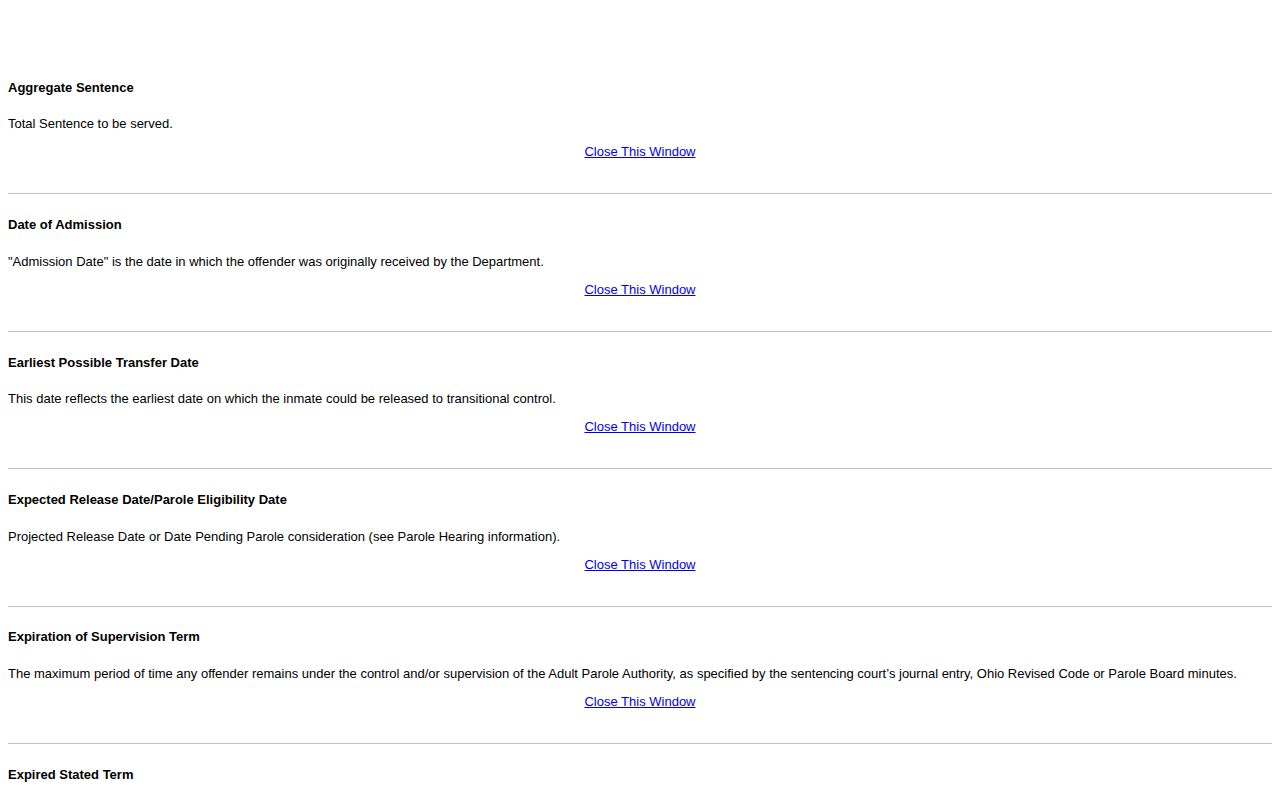
The definitions are the reason a future date should never be rewritten as a guaranteed release day. POA means parole on or after, while other transitional-control and sentence-expiration labels can describe distinct stages.
| ODRC field | Safe interpretation |
|---|---|
| Status | Whether the record says incarcerated, APA supervision, judicial release, released, or violator at large |
| Expected Release Date/Parole Eligibility Date | A projected date or date pending parole consideration, not automatic proof of exit |
| Parole or Release Detail | Release or parole information shown after the event and blank while incarcerated under ODRC's definition |
| Next hearing or review month | A scheduled review period that does not state the outcome |
| Latest review type and result | A record-specific decision that must not be relabeled as a different kind of review |
Ohio Credit and Hardin Release Dates
Ohio does not have one universal rule that everyone serves 85 percent of a sentence. Current ORC 2967.194, applicable beginning April 4, 2024, permits eligible people to provisionally earn one or five days for a completed month of productive participation. A second qualifying activity may add days. DRC may deny or withdraw provisional credit for rule violations.
Certain completion awards can be 90 days or ten percent of the stated term, whichever is less, within the statute's limits. The ordinary participation and completion credit in division (A)(2) has an aggregate 15-percent cap. The separate completion provision in division (A)(3) operates notwithstanding that cap. These details do not produce a sound one-line percentage rule.
Eligibility exclusions are broad. They include specified mandatory or nonreducible terms, death sentences, aggravated murder and murder categories, life without parole, certain Chapter 2971 terms, and specified sexually oriented offenses. The former scheme in ORC 2967.193 points to the current statute after the change date. OAC 5120-2-06 implements productive-program credit, while OAC 5120-2-03.2 separates calculation regimes from different sentencing-law eras.
Jail-time credit is not earned credit. Jail-time credit recognizes qualifying confinement before the prison calculation. Earned credit depends on the governing law, eligibility, participation, completion, and institutional action. Consecutive and concurrent terms, different offense dates, and mandatory specifications can make the web summary impossible to reproduce safely without the full official calculation.
Risk reduction is separate. ORC 2929.143 and OAC 5120-2-14 require court recommendation and statutory eligibility, then use mandatory time plus at least 80 percent of aggregated nonmandatory time, less applicable jail credit. A participant in that route does not also earn the ordinary ORC 2967.194 credit.
Note: The 15-percent cap in one earned-credit division does not mean every eligible sentence is reduced by 15 percent.
Why Hardin County Release Dates Change
A displayed date is a snapshot of facts and legal rules then known to the agency. Later action can move it, change its meaning, or replace it with an actual event. The source closest to each change should control that narrow issue: the sentencing court for its judgment, ODRC Central Records for the prison calculation, the Parole Board for its review, and MCCC for a local physical exit.
| Factor | Possible effect | Best record to check |
|---|---|---|
| Jail-time credit correction | Changes qualifying time credited before or toward the term | Filed court entry and ODRC calculation |
| Newly earned or withdrawn credit | Can move an eligible prison projection | ODRC record or Central Records response |
| Mandatory or consecutive term | May prevent a simple reduction or extend aggregate time | Sentencing journal and aggregate sentence fields |
| Appeal or corrected judgment | Can alter the sentence basis | Hardin court docket and corrected journal |
| Parole Board action | Eligibility may lead to review rather than immediate release | Review type, result, and later release detail |
| Detainer or agency hold | One custody term may end while another authority takes custody | Releasing agency, receiving agency, and court records |
| Judicial release or transitional control | May create a different release path under the governing order | Court order and ODRC status/detail |
One agency can truthfully mark a release while another continues custody. An MCCC Release Date may document transfer to ODRC. A BOP release can coexist with federal supervised release or state custody. An ICE released result addresses immigration custody only. Ask for the destination whenever the difference between transfer and return to the community matters.
MCCC Has No Published Release Formula
A local Hardin County jail sentence must not be calculated with ODRC earned-credit law. Use the Hardin court's imposed term, actual commitment date, filed jail-time-credit entry, any release order, and the MCCC jail register. The official MCCC site identifies the regional facility, while the public sheriff feed exposes booking and release timestamps. Neither source exposes the arithmetic, release reason, destination, or a local good-time calculation.
No published MCCC good-time formula was found. No official weekend or holiday release rule was found either. That absence is a material local finding. It prevents a reliable calculator and means another Ohio county's practice or the federal weekend rule cannot be borrowed for Hardin County.
If an expected local date falls on a closure day, call MCCC and ask whether processing is expected that day and whether another detainer blocks discharge. For a past event, request the jail-register entry and release sheet. ORC 341.02 requires the county jail register to include the date and manner of discharge, which is more useful than an unsourced formula.
A court order also should not be converted into an exact door-out time. It may precede receipt, verification, bond processing, and a hold check. Pair the filed order with the MCCC release timestamp or direct confirmation.
Note: Hardin Municipal bond payment in Kenton and physical release at MCCC in Marion are linked steps, but payment time is not exit time.
Confirm Hardin County Actual Release
When the date is still in the future, Ohio VINE can provide a custody-change alert for a participating jail or ODRC record. Search the correct source agency, match the identifier, and register for the events and delivery methods actually offered. The detailed registration process is covered on the Hardin County VINE inmate check. An alert is a prompt to verify, not a certified release paper.
For a completed local event, use the sheriff roster timestamp, MCCC status line, jail register, and correct court docket. For a completed prison event, read ODRC Status and Parole or Release Detail. APA Supervision means the person is outside prison under department supervision; it does not mean the sentence or supervision has fully ended.
If an ODRC date appears wrong, compare the sentencing journal and jail-time-credit entry. Then write ODRC Central Records at Attn: Central Records, P.O. Box 430, Columbus, OH 43216. Include the name, offender number, disputed field, and documentary support. ODRC publishes no universal fee or turnaround for this correction route, so none should be assumed.
For federal custody, a past date in the BOP inmate locator with no facility location, or a Released label, confirms departure from BOP custody only. A future BOP date remains projected. The ICE Online Detainee Locator can retain a person released from ICE custody in its recent window. USMS has no comparable nationwide released-person locator, so the federal docket, clerk, holding facility, or agency records process may be needed.