
ODRC Releases for Hardin Cases
The Ohio Department of Rehabilitation and Correction operates the state prison system. It does not operate the Hardin County jail. The Hardin sheriff's jail-location page identifies Multi County Correctional Center as the local adult facility. A person sentenced by Hardin Common Pleas Court may leave that jail and enter any institution ODRC designates. That local departure is a transfer between custodians, not a release to the community. The ODRC admission and institution fields show the next state-custody stage.
When prison custody ends, the public ODRC record may show Released, APA Supervision, or Judicial Release. APA means the Ohio Adult Parole Authority. APA Supervision shows that prison incarceration ended while department supervision remains. Judicial Release reflects a sentencing-court action and can also carry supervision terms. A plain Released status and a completed Parole or Release Detail are different from an expected date. Read the full detail before deciding which event occurred.
| ODRC or local event | What it means | Best record |
|---|---|---|
| MCCC departure to ODRC | Transfer into state custody | Hardin sentence, MCCC discharge entry, and ODRC admission |
| ODRC incarceration | Still confined in a state prison | ODRC status and institution details |
| APA Supervision | Outside prison under department control | ODRC release and supervision fields |
| Released or discharged | State record reflects a completed release event | Parole or Release Detail and Central Records material |
Custody layer: An MCCC release timestamp can mark an ODRC transfer, while an ODRC release describes departure from state-prison custody.
Confirm an ODRC Release
The official ODRC Offender Search is the first route for a Hardin-origin state-prison case. It searches people incarcerated in Ohio prisons, people under ODRC supervision, and judicially released people. It is not a complete archive of every former prisoner, and it does not cover a person whose custody ended at MCCC without a state-prison admission.
- Search by offender number when it is known, or enter the person's name.
- Use County of Commitment set to Hardin when the prison case began there.
- Select All, Released, or APA Supervision so the filter does not hide the status being checked.
- Match the offender number, birth date, committing county, docket, offenses, and admission data.
- Open the detail and read Status with Parole or Release Detail.
- Compare the expected date, supervision fields, and latest Board review before drawing a conclusion.
ODRC last-name searches use the typed text as a prefix, so the results may be broad. An offender-number search requires an A, R, or W prefix followed by six digits. A five-digit female number needs a leading zero. County of Commitment means the county tied to the prison commitment, not current residence. In multi-county cases, ODRC says the first listed county controls that filter. Use the Hardin Common Pleas record search to match the state record to the filed felony sentence.
The Hardin County released inmate search provides the separate MCCC, court, VINE, BOP, and ICE routes when the custody type is uncertain. Those tools should not be substituted for ODRC merely because one search returns no hit.
ODRC Release Search Fields
Search controls and detail fields answer different questions. The search form narrows possible matches. The detail page then supplies the sentence, custody, release, and supervision context needed to interpret one record. Residential County and ZIP apply only to APA Supervision or Violator at Large records. They reflect the last recorded address and are not a guaranteed current location.
| Field | Type | Required | How to read it |
|---|---|---|---|
| Last name | Text | No | Allows a prefix search and may return many names |
| First name | Text | No | Narrows a name match |
| Offender number | ID | No | Uses A, R, or W plus six digits |
| County of Commitment | County selector | No | Use Hardin for a qualifying Hardin-origin prison case |
| Status | Status selector | No | Offers All, Incarcerated, Released, APA Supervision, and Violators at Large |
| Residential County or ZIP | Location filter | No | Available for certain supervision records, not prison location |
| Next Board Hearing Date | YYYYMM | No | Returns people scheduled for that review month |
| Expected Release Date/Parole Eligibility Date | Detail value | No | May be a projected date or an eligibility date |
| Parole or Release Detail | Detail value | No | Appears after release or parole and is blank while incarcerated under ODRC's definition |
| Supervision and APA office | Detail values | No | Describe department control after prison release where applicable |
The search also can display a photograph, admission and institution data, offenses and Ohio Revised Code sections, counts, effective sentence date, jail-time credit, docket, judge, aggregate sentence, conditions, and hearing or review results. ODRC warns that sentencing data may be incomplete and that displayed supervision can relate to a prior offense. Match the court journal when those parts do not align.
The ODRC search form shows the released, supervision, and hearing-month controls available for this statewide check.
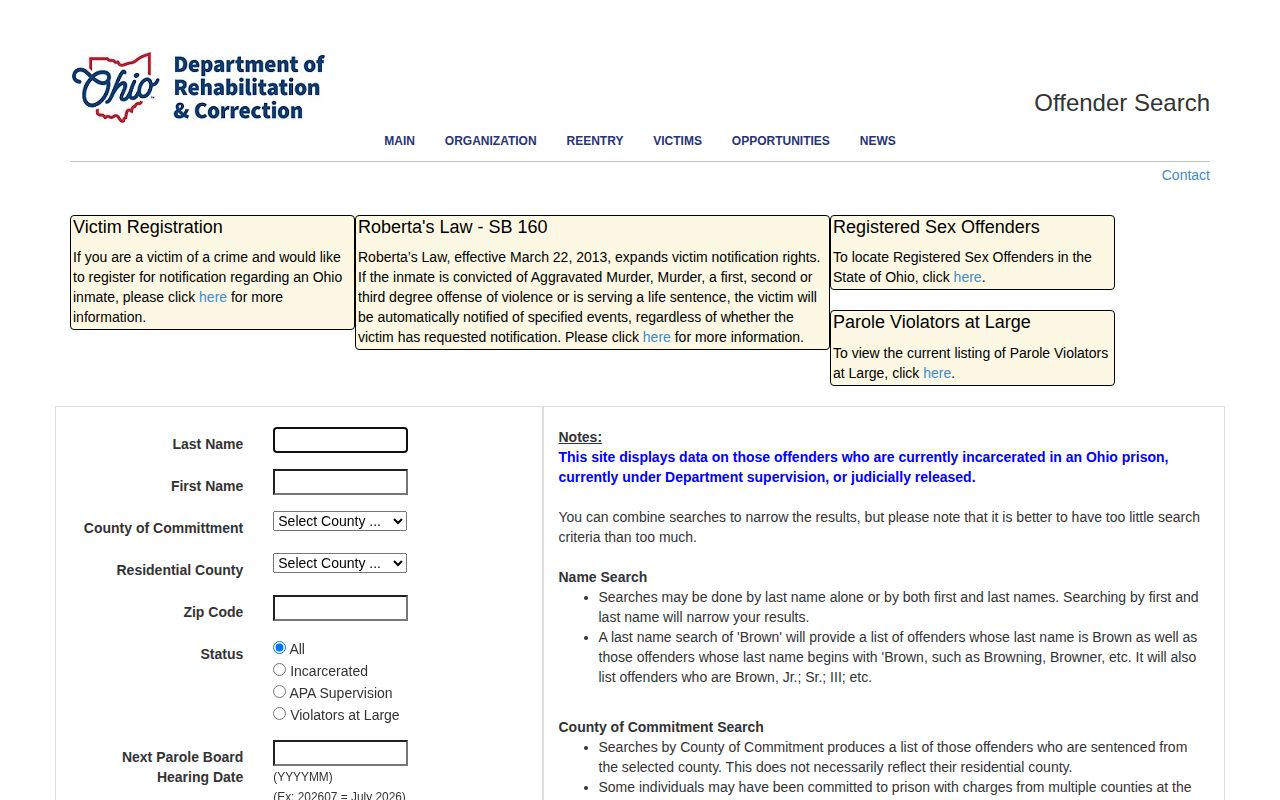
The form confirms that a released-person search needs a status choice broad enough to include release and continuing APA supervision.
ODRC Release Dates Need Context
The distinctive calculation issue on an ODRC record is built into the field label: Expected Release Date/Parole Eligibility Date. ODRC defines it as a projected release date or a date pending parole consideration. Those are not the same promise. A person with a future date and an Incarcerated status remains in prison. For a parole-eligible sentence, the date can mark when Board action becomes possible rather than the day the person will walk out.
Begin with the aggregate sentence and offense blocks. A definite term, a life or other parole-eligible term, and a qualifying Reagan Tokes indefinite term follow different rules. Then check mandatory parts and jail-time credit. Jail-time credit recognizes qualifying confinement before the prison calculation. It is not earned credit. Review the expected or eligibility date, any parole-on-or-after or transitional-control value, the latest review result, and finally Parole or Release Detail.
Ohio has no single rule that everyone serves the same percentage. ORC 2967.194 provides defined productive-participation and completion credits for eligible people, with caps, exclusions, and authority to deny or withdraw provisional credit. Sentence type, mandatory specifications, consecutive terms, corrected entries, sanctions, program completion, judicial release, transitional control, and Board action can all change the public date.
The official ODRC definitions show why projected release and parole eligibility must stay distinct.
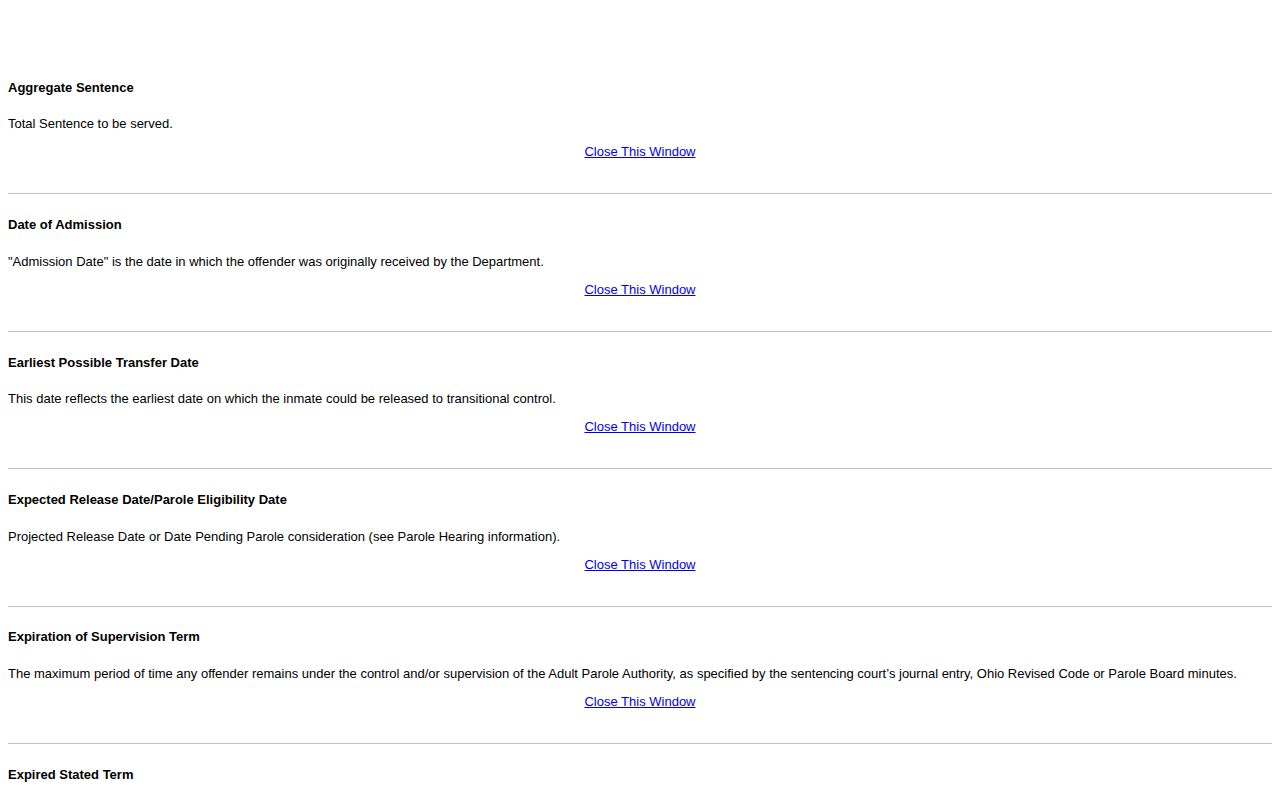
The combined label prevents a safe home calculation from one web field. Central Records and the filed sentencing journal are the better sources when the date appears wrong.
Note: A future ODRC date is not proof of release; current status and completed release detail must confirm the event.
ODRC Discharge Records and Contact
Ohio Revised Code 5120.21 requires ODRC to maintain an institutional record that includes discharge date, cause, terms, condition on leaving, and transfers. The same law limits access to the full inmate and APA file. Publicly disclosable items include the person's name, convictions, photograph, supervision status, current or past place of incarceration, and disciplinary history. The public search is therefore not the same as a complete discharge file.
For a record question, identify the person by name and offender number. Ask for clarification of the displayed release status or date and for the public portion of the discharge or release record. If a jail-time-credit or sentence value appears wrong, attach the filed court journal or corrected entry. Ask ODRC to identify any segregated public material and the authority for any withheld part.
ODRC Central Records
Attn: Central Records
P.O. Box 430
Columbus, OH 43216
Public state-prison status and record questions
ODRC Victim Services
P.O. Box 430
Columbus, OH 43216
1-888-842-8464, option 1
Fax: 614-728-1980
No direct Central Records release-record phone, fee, response time, or walk-in hours were verified. Do not assume a county clerk's copy schedule applies to ODRC. For formal victim notification, Office of Victim Services uses its own registration process. Ohio VINE is a separate alert relay, not an automatic substitute for that registration or a certified discharge record.
ODRC Parole Review Records
The Ohio Parole Board operates within ODRC. Its verified public schedule route is the Offender Search hearing field, entered as a YYYYMM month. Results form a month-based list. An individual's detail can show the next hearing or review month and the latest review type and result. No separate static statewide calendar or universal decision database was verified in the research.
Review wording must stay exact. A transitional-control denial is not automatically a parole denial. A future expected or eligibility date may lead to review about two months before that date under ODRC's definitions, but this is an approximate relationship rather than a fixed timetable. Eligibility depends on the offense and sentence, including ORC 2967.13. It does not guarantee a release result.
When a record shows APA Supervision after release, the supervision start, period, end, office, and conditions can describe ongoing control. Violator at Large is an absconder status under state law. A displayed residential address is only the last one recorded before that status, not a current location. Actionable safety information belongs with law enforcement.
Note: Board eligibility, a scheduled review, and an actual ODRC prison release are three separate events in the public record.
Hardin and ODRC Release Distinctions
No adult ODRC prison was found in Hardin County. Marion Correctional Institution is nearby but lies in Marion County and is separate from MCCC. The official MCCC site describes the regional jail, not a state prison. A Hardin defendant can be housed anywhere ODRC assigns. The correct statewide search is based on the state custody record, not on the name of the county where the conviction began.
Local and state records can both be accurate at different points. MCCC records its own discharge or transfer time. Hardin Common Pleas records the sentence and later court orders. ODRC records admission, institution placement, prison release, and APA supervision. If MCCC shows a release date followed by ODRC admission, the sequence supports a transfer into prison, not a return home. The Multi County Correctional Center release page covers that regional-jail side of the custody trail.
Federal and immigration systems remain separate. A BOP Release Date applies only to Bureau of Prisons custody. ICE's locator can retain a recent release from ICE custody, while the U.S. Marshals Service has no comparable nationwide public released-person locator. Neither system confirms an ODRC discharge. A handoff to any other authority is still a transfer from the first agency, not proof that all custody has ended.
Released, discharged, and supervised should always be tied to the agency reporting them. That rule keeps a Hardin jail exit, an Ohio prison release, and a later supervision record from being merged into one misleading event.